QuickPulse EA — Post-Mortem
QuickPulse is one of our free Expert Advisors, and this page is a post-mortem rather than a sales pitch: a corrected backtest run showed the strategy does not clear our quality gate on any pair, and we are publishing the failure in the open instead of quietly retiring the page. Read the withdrawal notice below before considering it.

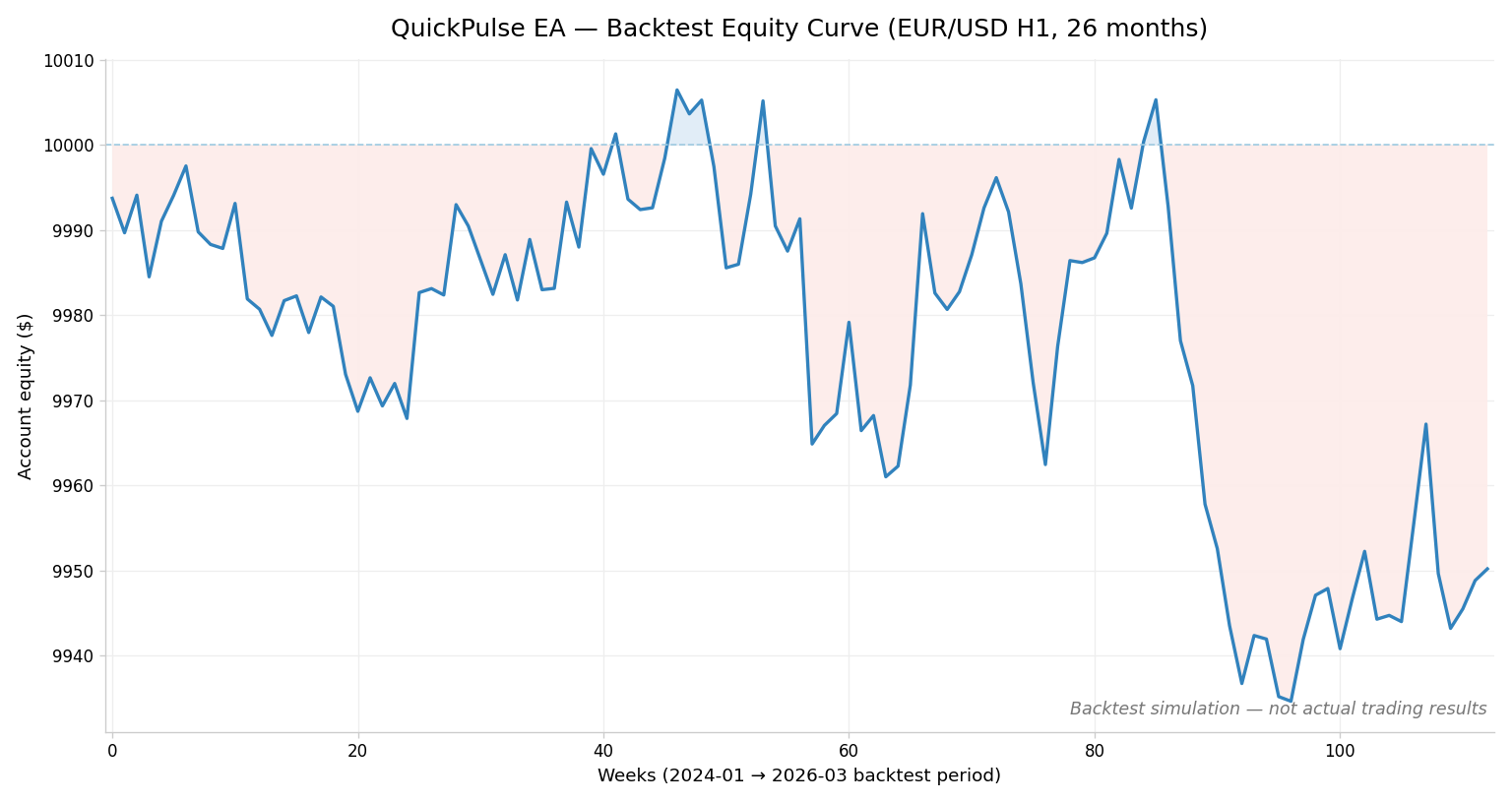
Do not run this EA on a funded account yet. On July 30, 2026 we found and fixed a defect in our backtest engine that had inverted the intrabar high and low on every price bar. Re-running QuickPulse on corrected data flipped the result: it no longer passes our quality gate on any pair, and every pair finishes flat to slightly negative over the test window. The numbers below are the corrected ones. The EA stays available for download and study, but we are withdrawing our recommendation until a re-worked version passes on clean data. Full disclosure on the performance page.
Download QuickPulse — Free, No Registration Required
Because QuickPulse is retired from our live-use recommendation rather than a strategy we’re promoting, we don’t gate it behind an XM account signup like our other six EAs. Download it directly for study or demo testing — no account number, no email, no form:
As the withdrawal notice above explains, the corrected backtest failed on every pair we tested — treat this as study material for a demo chart, not a live-trading recommendation. Our other six EAs are also free but require a quick XM account verification on the download page.
QuickPulse is a free contrarian Expert Advisor for MetaTrader 4 and MetaTrader 5 — one of several distinct types of automated trading algorithms we publish. It watches a fast 6-period RSI for the exact moment momentum washes out — the bar where RSI first crosses into extreme territory — then takes the other side with a deliberately lopsided trade: a tight 1.3× ATR stop against a 6× ATR target. The intent is that most trades lose small while the winners pay for them several times over. On our corrected 26-month test the winners did not quite pay for the losers — see the results below.
How It Works
- Washout trigger — A buy fires on the bar where RSI(6) first crosses down through 25; a sell fires when it first crosses up through 75. Only the crossing bar counts — QuickPulse doesn’t keep firing while RSI sits in the extreme zone
- Slow volatility anchor — Stops and targets are sized from a long ATR(50), so a single news candle doesn’t distort trade geometry
- Asymmetric exits — Stop-loss 1.3× ATR, take-profit 6.0× ATR. The win rate is deliberately low (~18% in corrected backtests) because each winner is worth ~4.6 losers — which, on corrected data, is no longer quite enough to cover them
- One trade at a time — No stacking, no averaging; each signal is an independent, fully-stopped position
Key Features
| Feature | Details |
|---|---|
| Strategy | Fast-RSI washout, contrarian entry |
| Timeframe | H1 (recommended) |
| Pairs | Tested on EURUSD, GBPUSD, USDJPY — none currently recommended |
| Indicators | RSI (6), ATR (50) |
| Risk per trade | 1.5% (configurable) |
| Stop-loss | 1.3× ATR (tight) |
| Take-profit | 6.0× ATR (≈ 1:4.6 R:R) |
| Max positions | 1 (no stacking, no martingale) |
| Platform | MetaTrader 4 and MetaTrader 5 |
| Price | Free |
Backtest Results (2024-01 → 2026-03, H1) — corrected July 30, 2026
| Pair | Trades | Profit Factor | Win Rate | Max Drawdown | Net Return |
|---|---|---|---|---|---|
| EURUSD | 521 | 0.93 — did not pass | 17.5% | 0.9% | −0.50% |
| GBPUSD | 521 | 1.00 — did not pass | 19.0% | 0.7% | −0.01% |
| USDJPY | 556 | 0.94 — did not pass | 17.8% | 2.2% | −0.57% |
Backtests use bid-candle data with spread modelled. No pair passes our internal quality gate (PF > 1.3). EURUSD and USDJPY finish slightly negative; GBPUSD is essentially flat. Past performance is not indicative of future results — and in this case the past performance is not good.
Net return is the change in the test account’s balance over the whole window, on the $10,000 it started with. It is a fraction of a percent for the same reason the drawdown is: the harness commits about 10% of the account’s free equity per trade with no leverage on top, so return and drawdown scale together — why the figures look small.
The figures we published before July 30, 2026 (EURUSD PF 1.44, USDJPY 1.35, GBPUSD 1.26 on roughly 320–370 trades) were produced by an engine that inverted every bar’s high and low. On corrected data the strategy trades far more often and the winners no longer pay for the losers. We are leaving the failed numbers on this page rather than quietly removing the EA.
What We Learned
Three things came out of this correction that changed how we operate, not just what we publish:
- A design can be internally coherent and still fail. QuickPulse’s 1:4.6 risk-reward math only needs an ~18% win rate to break even, and the strategy does land close to that line (17.5–19.0% across pairs) — the logic isn’t broken, the edge just isn’t there on corrected data. Coherent reasoning about a strategy is not evidence that it works; only the test result is.
- A single decoding bug can invalidate an entire result set at once, because stop-loss/take-profit touch checks, ATR, and ADX all depend on the same high/low values. QuickPulse happened to be the EA whose numbers moved from “passes” to “fails” the most visibly, which is exactly why we re-ran and republished every EA’s figures rather than only the ones that looked suspicious. See the full correction record.
- Publishing a failure is cheaper than hiding one. Nothing about QuickPulse’s page traffic or download count required us to disclose this — we chose to because a testing pipeline you only trust when it produces good news isn’t one you can trust at all.
Where to Go Instead
If you came here looking for a mean-reversion or contrarian-style EA, SnapBack covers similar ground with a symmetric 1:1 setup and currently passes our quality gate on EURUSD and GBPUSD. If you want a trend-following EA with a tested, published track record, DualHorizon passes on EURUSD. Both pages carry the same corrected, July 30, 2026 figures — see the full comparison on the performance page.
Risk Controls (Built In)
These settings limit how much a single configuration can lose; they do not make automated trading safe.
- Tight hard stop on every trade — 1.3× ATR, placed at entry, never widened
- Low win rate by design — The math relies on cutting losers immediately, which the EA enforces mechanically
- No averaging / no martingale — Maximum 1 open position at a time
- Daily trade limit — Max 8 entries per day
- Automatic lot sizing — Position size derived from account balance × risk %
Best For
Demo accounts and study, not live capital. With no pair passing the quality gate on corrected data, we do not have a use case we can honestly recommend. If you want to run it, run it on a demo account and judge it yourself.
Settings As Tested
These are the parameters behind the corrected table above — they are the EA’s defaults, unchanged. We have deliberately not re-tuned them to recover the old numbers; doing that after seeing the answer would only be curve-fitting.
- Risk percent: 1.5% (default) — losing streaks are normal for this profile, so size conservatively
- RSI period / levels: 6, 25/75 (defaults, as backtested)
- ATR period: 50
- SL / TP multipliers: 1.3× / 6.0× ATR
- Pairs tested: EURUSD, GBPUSD, USDJPY — none passed
- VPS: Recommended for uninterrupted operation
Getting Started
- Download QuickPulse using the buttons above — no XM account or registration required
- Install on MetaTrader following our step-by-step guide
- Attach to an H1 chart on a demo account and confirm “AutoTrading” is enabled — see the correction notice above before considering live capital
- Want a broker account too, for QuickPulse or one of our other six EAs? Open a free XM account and see the full download page for the rest of the lineup
Frequently Asked Questions
Why is the win rate under 20%? Is that bad? A low win rate is the design — with a 1:4.6 risk-reward ratio, QuickPulse only needs to win about 18% of trades to break even. The problem is that in the corrected backtest it lands almost exactly on that break-even line (17.5–19.0%) rather than above it, which is why no pair passes. The design is coherent; the measured edge is not there.
Should I still use QuickPulse? Not with real money on our recommendation. Every pair we tested finished flat or slightly negative on corrected data. We are keeping the download and the failed numbers published rather than deleting the page, because the honest record is more useful to you than a tidy one.
How is QuickPulse different from SnapBack? Both enter against the recent move, but SnapBack takes quick symmetric profits at statistical extremes (high win rate, 1:1), while QuickPulse risks little to catch the occasional large recovery (low win rate, 1:4.6). They monetize the same market behavior in opposite ways.
Is it safe to study QuickPulse on a demo account alongside other EAs? Yes — on a demo it behaves like any other EA on its own chart, tagging orders with magic number 103001, so it won’t interfere with anything else you’re testing. On a live account our recommendation is simply not to run it at all; see the withdrawal notice above.
How many trades is the failed verdict based on? About 520–560 trades over the 26-month corrected test — roughly 5 per week on H1, one per washout episode. A sample that size makes the flat result unlikely to be bad luck, which is exactly why we retired the EA rather than re-tuning parameters until something passed.
Do I need to register or open an XM account to download QuickPulse? No. QuickPulse is retired from our live-use recommendation, so unlike our other six EAs it is not gated behind an XM account number — download the .ex4 or .ex5 file directly above with no form, no account, and no email. Our other six EAs still require a free XM account verification on the download page.
Further Reading
- Technical Analysis Basics — RSI and ATR fundamentals
- How to Install an EA on MetaTrader — step-by-step setup
- How to Backtest a Forex EA — validate settings before going live
- Forex Risk Management Guide — essential risk management
- VPS for Forex Trading — keep the EA running 24/7
Contrarian trading involves significant risk — momentum can continue against the position, and losing streaks are an expected part of this strategy’s profile. Past performance is not indicative of future results. Please read our risk disclosure before trading.