Best Currency Pairs for Beginners
The usual advice — “trade the majors, avoid exotics” — is correct but too vague to act on. The real decision is a cost comparison: what you pay in spread relative to how far the pair typically moves in a day. A tight-looking spread on a pair that barely moves can still cost more of the available profit than a wider spread on a pair that moves a lot.
This decision is one step in our forex trading for beginners roadmap — pair choice, not strategy, is usually the first mistake new accounts make.
The Decision Table
| Pair | Published typical spread | Avg. daily range (pips) | Spread as % of daily range | Peak session | Cost rank (1 = cheapest) |
|---|---|---|---|---|---|
| USD/JPY | 1.5 pips (as published by XM, July 2026) | 94 | 1.6% | Tokyo, NY overlap | 1 |
| GBP/USD | 1.9 pips (as published by XM, July 2026) | 76 | 2.5% | London | 2 |
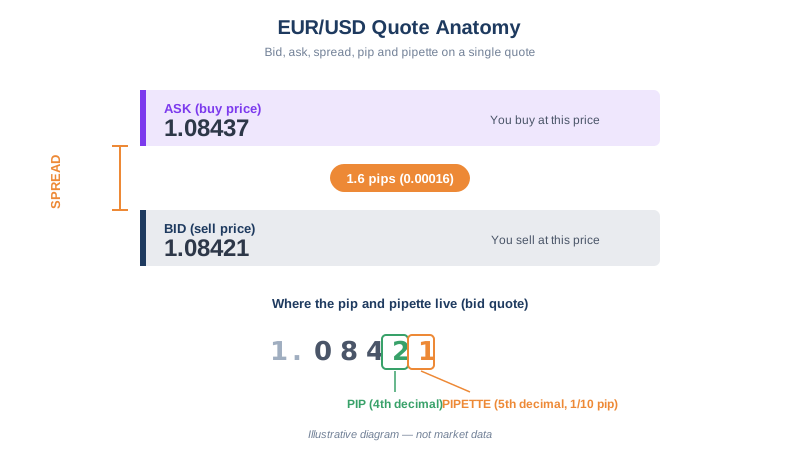
| EUR/USD | 1.6 pips (Standard, as published by XM, July 2026) | 60 | 2.7% | London/NY overlap | 3 |
| AUD/USD | 1.6 pips (as published by XM, July 2026) | 49 | 3.3% | Asian/London crossover | 4 |
| USD/CHF | not separately published by XM; typically close to EUR/USD, roughly 1.8–2.2 pips | 49 | ~3.7–4.5% | London | 5 |
The rank column sorts by the cost metric, not the raw spread — it is the same “spread as % of daily range” column, reordered so the cheapest pair to trade is on top. That single change flips the usual “EUR/USD is cheapest” assumption: on this measure, USD/JPY comes out ahead because its range is nearly double EUR/USD’s for a similar published spread.
Daily range figures: Dukascopy hourly bid candles resampled to daily, window 2025-07-01 to 2026-06-30 — see the chart below. “Spread as % of daily range” is the spread divided by the average daily range; it is the real cost metric, because it tells you what fraction of a typical day’s movement is paid away just to enter.

Two things the table makes explicit that “tightest spread” alone doesn’t: USD/JPY has the widest published spread-in-pips of the four XM-listed pairs here but the lowest cost as a share of its own range, because its daily range is nearly double EUR/USD’s. And AUD/USD, despite a spread matching EUR/USD’s, costs proportionally more because it moves less per day.
USD/CHF has no separately published spread on XM’s own table — a real gap, not an oversight we’re papering over. Its historical relationship to EUR/USD (below) means a spread close to EUR/USD’s is a reasonable estimate, but “reasonable estimate” is not the same as a published figure, and you should check your account’s live quote before relying on it.
Correlation Between the Five
Trading two currency pairs that move together is not diversification — it’s the same bet, sized twice. The sign matrix below is directional, not exact:
| Pair pair | Typical relationship |
|---|---|
| EUR/USD & GBP/USD | Positive — both are “USD weak/strong” trades |
| EUR/USD & USD/CHF | Strongly negative |
| EUR/USD & AUD/USD | Positive, weaker than GBP/USD |
| EUR/USD & USD/JPY | Weak — among the most independent pairings here |
| GBP/USD & USD/CHF | Negative — mirrors the EUR/USD-USD/CHF relationship |
| GBP/USD & AUD/USD | Positive — both trade as “risk-on, USD-quote” pairs |
| GBP/USD & USD/JPY | Weak — JPY crosses run on different drivers |
| AUD/USD & USD/CHF | Negative — AUD leans risk-on, CHF leans safe-haven |
| AUD/USD & USD/JPY | Weak, with some shared sensitivity to risk sentiment |
| USD/CHF & USD/JPY | Weak — among the most independent pairings here |
EUR/USD and USD/CHF are the clearest case: both price the dollar against a European safe-haven-adjacent currency, so they move as near-mirrors. Holding both in the same directional view doubles a single dollar exposure rather than spreading risk. GBP/USD and AUD/USD sit further along the same spectrum — both tend to weaken when the dollar strengthens broadly, just less tightly than the EUR/USD-USD/CHF pair, so combining them still concentrates risk, only less severely. USD/JPY is the outlier of the five: yen crosses respond to their own rate-differential and risk-sentiment drivers, so pairing USD/JPY with any of the other four comes closer to genuine diversification than any other combination in the table — though “closer to” is not the same as independent, and position size should still account for some shared USD sensitivity. See our risk management guide for position sizing across correlated pairs.
“Avoid Exotics” Is Really About Cost
The standard beginner warning — avoid GBP/JPY, EUR/TRY, USD/ZAR — is correct, but the reason is the same cost-as-percentage-of-range math from the table above, just worse. A retail USD/TRY spread commonly amounts to a large share of the pair’s own average daily range, paid away at entry — several times what EUR/USD’s 2.7% costs. The pip-spread number alone hides this; only comparing it to the pair’s own range shows it.
| Pair | Cost profile vs. this table’s majors | Why avoid |
|---|---|---|
| GBP/JPY | Wider spread stacked on higher volatility | High volatility and a wide spread compound each other |
| EUR/TRY | Spread multiples wider than any pair above | Wide spread against a currency prone to large, policy-driven gaps |
| USD/ZAR | Spread multiples wider, plus thin liquidity | Low liquidity, unpredictable moves outside major sessions |
| Any exotic | Rarely published as cleanly as the five majors above | The published spread rarely tells the whole cost story — check it against the pair’s own range before trading it |
How to Choose One Pair and Stop
Beginners who trade one major pair for their first 100 trades build something switching pairs constantly prevents: a specific, comparable sense of how that pair behaves — its typical range, its spread cost, how it reacts around its own session open and around news. That pattern recognition resets every time the pair changes. EUR/USD is the conventional starting choice on the cost table above, but the specific pair matters less than staying on it long enough to actually learn its behaviour before adding a second.
- Pick one pair from the table above
- Trade it on demo until you can describe its typical daily range and typical spread from memory
- Only then add a second pair, checking correlation against the first
Frequently Asked Questions
What is the single best currency pair for a beginner?
EUR/USD is the conventional pick, but not because it tops the cost-rank column above — USD/JPY actually has the lowest spread as a share of its own daily range (1.6% vs. EUR/USD’s 2.7%). EUR/USD’s case rests on other things instead: the tightest raw published spread among these five, the deepest liquidity, and by far the most available beginner analysis. That combination, not the cost-rank number alone, is why it stays the default starting pair — and none of it makes it profitable, only cheaper to be wrong on.
Why do EUR/USD and USD/CHF move opposite to each other?
Both price the same US dollar against a European safe-haven-adjacent currency, so USD strength tends to push EUR/USD down and USD/CHF up together — a strongly negative correlation over time. Trading both at once in the same direction isn’t two independent positions; it’s close to one dollar bet, sized twice.
Is it actually more expensive to trade an exotic pair like USD/TRY?
Yes — measure cost as a share of daily movement, not raw pips. A retail USD/TRY spread commonly eats a large share of the pair’s own average daily range — a substantial portion of a typical day’s movement paid away before the trade can move into profit.
How many currency pairs should a beginner trade at once?
One. Committing to a single major pair for the first 100 trades builds a specific read on its typical range, spread cost, and behaviour that resets every time you switch. Add a second only once you can describe the first from memory.
- Forex Trading for Beginners — the full roadmap this pair choice fits into
- Forex Trading Sessions Explained — why peak session affects the same pair’s spread cost
- Forex Risk Management Guide — sizing correctly once you’ve picked a pair
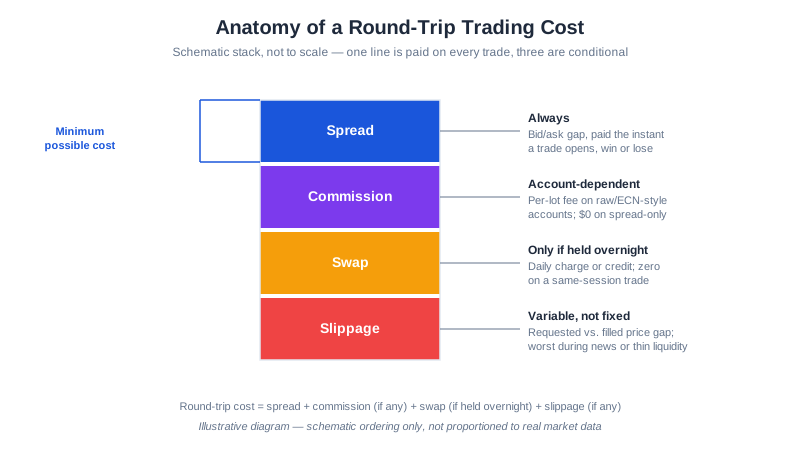
- Understanding Spreads and Commissions — the cost math behind this table
Ready to test one of these pairs without risking capital? Open a free XM account and trade them on demo first.
This article is for educational purposes only. Trading forex carries significant risk. Always practice on a demo account first.