Forex Trading Sessions Explained
The forex market runs 24/5, but it is really four regional sessions handing off to each other, not one continuous market with even conditions. Volatility, liquidity, and spreads shift with which financial centre is open — and, the part most guides skip, the GMT hours for each session move twice a year as different countries switch their clocks on different dates.
Session timing is one of the practical basics covered in our forex trading for beginners roadmap, alongside pair choice and position sizing.
The Four Sessions
Sydney — opens the trading week. Lower volume than the other three, active mainly for AUD/NZD pairs.
Tokyo (Asian) — 00:00–09:00 GMT, unaffected by DST. Lower volatility, tighter ranges. Key pairs: USD/JPY, AUD/USD, NZD/USD — best suited to range-based strategies.
London (European) — the heaviest-volume session, roughly 07:00–16:00 GMT in summer. Key pairs: EUR/USD, GBP/USD, EUR/GBP — best suited to trend-following and breakouts.
New York (American) — roughly 12:00–21:00 GMT in summer, overlapping London’s first four hours. Key pairs: USD/CAD and USD pairs generally — best suited to momentum and news-driven strategies.
Session Overlaps
London + New York is the busiest window: highest volume, tightest spreads, strongest moves. Tokyo + London is a smaller pickup as European traders react to overnight Asian-session moves.
Planning a Trading Day Around the Overlaps
A worked walk-through, hour by hour in GMT, built on the session hours above and the hourly volatility data further down this page. It uses the northern-hemisphere summer session hours from the table above — shift the clock hours according to the current DST state before applying it (see the next section for why).
| GMT window | Session context | What the data below shows | Practical read |
|---|---|---|---|
| 00:00–07:00 | Tokyo running alone | Lower average range through the small hours, with a clear lull around 03:00–04:00 (~7.7–7.8 pips) | Range-based setups fit this window; a directional idea formed here still needs the busier hours to confirm |
| 07:00–08:00 | London opening | Range picks up to ~15.6–16.1 pips as London liquidity arrives | Spreads start tightening; a good point to review overnight Tokyo moves against a fresh session, not to chase the opening print |
| 08:00–12:00 | London running, ahead of the NY overlap | Building volume, EUR/USD and GBP/USD most active | Trend-following and breakout setups get more reliable follow-through here than in the Tokyo hours |
| 12:00–15:00 | London + New York overlap | Peak average range, ~19.1–20.4 pips, topping out near 14:00 | The busiest window: highest volume, tightest spreads relative to movement, and the largest moves in both directions — position sizing matters most here, not less |
| 15:00–16:00 | London closing into the NY afternoon | Volume starts thinning as London desks wind down | A natural point to review or trail stops on positions opened during the overlap, before London-side liquidity leaves the market |
| 16:00–21:00 | New York alone | Range declining toward the day’s low | US data releases can still move price, but follow-through is thinner without London behind it |
| 21:00–22:00 | NY closing, Sydney opening | Lowest average range of the day, ~7.5 pips near 21:00 | Widening spreads and thin liquidity make new positions harder to justify here; a reasonable point to flatten day trades instead |
None of this is a signal or a prediction — it reuses the same measured hourly-range shape from the table below as a planning frame instead of just a chart. The two windows worth building a day plan around are the London open (spreads tighten, session data arrives) and the London/New York overlap (the volatility peak); the two windows worth deliberately doing less in are the Tokyo lull and the New York close, both visible as the low points in the same data.
Session Times Shift Twice a Year
Every “session runs from X to Y GMT” table, including the one above, is accurate for only part of the year, because daylight saving isn’t synchronised across regions:
- UK/EU shift on the last Sunday of March and of October.
- US shifts on the second Sunday of March and first Sunday of November — two to three weeks apart from the UK/EU in spring, about a week apart in autumn.
- Japan doesn’t observe DST — Tokyo’s GMT hours are fixed year-round.
- Australia observes DST on the opposite cycle to the Northern Hemisphere, so Sydney shifts in the reverse direction to London and New York.
| Session | Local hours | GMT — N. Hemisphere winter | GMT — N. Hemisphere summer |
|---|---|---|---|
| Sydney | 09:00–17:00 | 22:00–06:00 (AEDT, DST) | 23:00–07:00 (AEST, standard) |
| Tokyo | 09:00–17:00 JST | 00:00–08:00 (no change) | 00:00–08:00 (no change) |
| London | 08:00–16:00 | 08:00–16:00 (GMT) | 07:00–15:00 (BST) |
| New York | 08:00–16:00 | 13:00–21:00 (EST) | 12:00–20:00 (EDT) |
Most MT4/MT5 brokers, XM included, don’t run the platform clock on GMT — they use a floating offset, commonly GMT+2 in winter and GMT+3 in summer, tracking Eastern European Time. Because that offset shifts on the same dates as London’s own clock, London’s broker server-time window works out constant year-round: 08:00+2 in winter = 07:00+3 in summer = 10:00 server time, giving 10:00–19:00 both seasons. New York works out constant too, at 15:00–00:00, by the same arithmetic — but only once both the US and EU have finished their own transition for the season. Confirm your own broker’s stated offset rather than assuming GMT+2/+3.
Volatility by Hour, With Real Data

As published by Dukascopy (hourly bid candles), July 2025–June 2026, on EUR/USD:
| GMT hour(s) | Avg. hourly range | What’s happening |
|---|---|---|
| 14:00 | ~20.4 pips (peak) | London/New York overlap |
| 12:00–15:00 | ~19.1–20.4 pips | London/New York overlap window |
| 07:00–08:00 | ~15.6–16.1 pips | London open |
| 03:00–04:00 | ~7.7–7.8 pips (low) | Tokyo afternoon lull, before London |
| 21:00 | ~7.5 pips (low) | New York afternoon, thinning into the close |
The overlap window carries roughly two and a half times the range of the quietest hours. That is EUR/USD alone; the forex volatility by hour guide runs the same hourly measurement across all 28 pairs we track, with the widest and quietest UTC hour for each one.
What Actually Changes Between Sessions
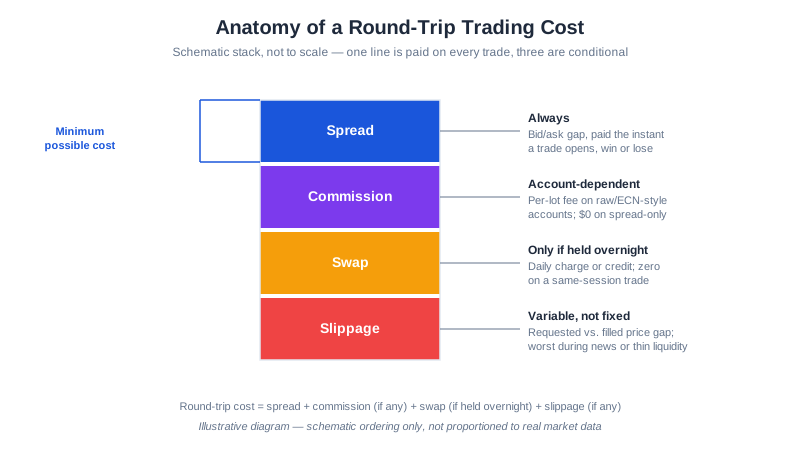
Spread behaviour. Tightest when liquidity is deepest — London and the London/NY overlap — and widest during the Sydney/Tokyo handoff and around the NY close, when fewer market makers are quoting.
Liquidity. More participants means orders fill closer to the quoted price; thin liquidity (Sydney open, NY close) means the same order size moves price further.
Which data lands when. European releases land during the London morning; US releases land during the NY morning, often inside the overlap window.
Month-end fix flows. The WM/Reuters 4pm London fix, used by index funds and corporates to value foreign holdings, concentrates large rebalancing orders around 16:00 London time — most visible on the last trading day of the month, and unrelated to any news event.
Setting EA Trading Hours
Most EAs restrict trading to a configured hour window, in GMT or the broker’s server time. Two things go wrong in practice: mixing up which one your input is in — a GMT figure entered where the EA expects server time trades two or three hours off target — and filters calibrated once and never revisited. A filter set to “12:00–16:00 server time” drifts during the two-to-three-week stretch each spring, and roughly one week each autumn, when the US and EU sit on different DST states from each other. New York — the one session here without a stable year-round offset — moves an hour relative to the filter during exactly those weeks, and the filter doesn’t correct itself. Recheck hour filters at each DST changeover, not just once at setup.
Best Times for Each Strategy
| Strategy | Best window | Why |
|---|---|---|
| Trend following (SteadyPips) | London, London+NY overlap | Strongest directional moves form here |
| Grid trading (GridMaster) | Tokyo, other quiet periods | Ranges suit grid spacing better than trending moves |
| Scalping | London+NY overlap | Tightest spreads relative to movement |
| Swing trading | Any | Holds across multiple sessions by design |
Times to Avoid
- Sunday open (~22:00 GMT) — thin liquidity, wide spreads, possible weekend gaps
- Friday close (~21:00 GMT) — liquidity draining ahead of the weekend
- Major holidays — thin markets, erratic moves
- Scheduled high-impact news, unless the strategy is built for it
Frequently Asked Questions
What are the four forex trading sessions?
Sydney, Tokyo, London, and New York, named for the financial centre driving each, running back to back across the day. Sydney opens the week, Tokyo follows, London opens next with the heaviest volume, and New York overlaps London’s afternoon before the day closes. Each shifts on its own daylight-saving calendar — see the table above.
Why do session times in GMT change twice a year?
Daylight saving. The UK/EU shift on the last Sunday of March and October; the US shifts on the second Sunday of March and first Sunday of November — different dates. Japan doesn’t observe DST, so Tokyo’s GMT hours never move. Australia’s DST runs on the opposite cycle to the Northern Hemisphere, so Sydney shifts in the reverse direction to London and New York.
What is the single best time to trade forex?
By our published data (Dukascopy hourly EUR/USD candles, July 2025–June 2026), the 12:00–15:00 GMT overlap carries the largest average hourly range, peaking near 14:00 GMT at roughly 20 pips — see the table above. That’s a volatility measurement, not a profitability guarantee: wider ranges mean bigger moves in both directions.
Why did my EA’s trading-hours filter stop working correctly?
Most hour filters use a fixed GMT or server-time window. Because the US and EU shift daylight saving on different dates, several weeks each spring and autumn put New York’s session an hour off from where the filter expects it. The filter doesn’t self-correct — recheck it at each DST transition.
- Forex Trading for Beginners — the full roadmap this guide is one module of
- Best Currency Pairs for Beginners — which pairs move most in which session
- Understanding Spreads and Commissions — why spreads widen outside overlap hours
- Forex Session Volatility Table — the measured Tokyo, London and New York range in pips for 28 pairs, from the same Dukascopy data as the chart above
- Most Volatile Day of the Week in Forex — the same 28 pairs’ daily range split by weekday
- Grid Trading Strategy: Complete Guide — why grid systems care about session volatility too
This article is for educational purposes only. Trading forex carries significant risk. Past performance is not indicative of future results.