Forex Lot Sizes Explained
Lot size is the one input that converts a price move into a dollar amount. Get it wrong and every other part of your plan — stop placement, risk percentage, reward-to-risk ratio — is describing a trade you are not actually taking.
This page assumes you already know what a pip and a lot are. If you are still working through the fundamentals, start with our forex trading for beginners roadmap, then come back here to get the sizing arithmetic right before you risk real money.
Quick Answer
There are four lot sizes, each one tenth of the one above it: a standard lot is 100,000 units of the base currency, a mini lot 10,000, a micro lot 1,000, and a nano lot 100. On a pair quoted in US dollars that makes one pip worth $10.00, $1.00, $0.10 and $0.01 respectively — so a 50-pip stop risks $500, $50, $5 or $0.50. That $10 figure is not universal: a pip is worth 10 units of the quote currency per standard lot, so on USD/JPY it is ¥1,000, which converts to $6.67 at an illustrative rate of 150.00, and on USD/CHF it is 10 francs. Lot size (also called trade size or position size) is the only term in profit or loss = pips moved × pip value per lot × trade size in lots that you control, which is why it is the lever every risk rule actually operates on.
This is a reference page — a stack of lookup tables and two calculators. Jump to whichever one you came for:
| If you want to know… | Go to |
|---|---|
| What a standard, mini, micro or nano lot is | The four lot sizes |
| What one pip is worth on your pair | Pip value by pair |
| The smallest account that can trade 0.01 lots properly | Minimum lot size as a risk floor |
| The lot size for your balance and stop | Lot size by account and stop |
| Why your broker’s number differs from yours | Errors that silently change your risk |
What Is Trade Size in Forex?
Trade size and lot size are the same thing: the quantity of currency a position controls, quoted in lots. It is the number you type into the “Volume” field in MetaTrader, and it is what turns a move measured in pips into a result measured in money.
That relationship is the whole reason the term matters:
profit or loss = pips moved × pip value per lot × trade size in lots
Two of those three terms are outside your control. The market decides the pips. The pair and its quote currency decide the pip value. Trade size is the only variable you set, which makes it the only lever you have over how much a given trade can cost you. A trader who says “I risk 1% per trade” is really describing a rule for choosing trade size.
You will also hear position size, which means the same thing again. The three terms are interchangeable in retail forex; the arithmetic below applies to all of them.
The Four Lot Sizes: Reference Table
A lot is a standardised quantity of the base currency — the first currency named in the pair. The four sizes are fixed conventions, but the pip value column below holds only for pairs quoted in US dollars, which is where most lot-size articles go wrong.
| Lot type | Volume field | Units of base currency | Pip value on a USD-quoted pair | Risk on a 50-pip stop |
|---|---|---|---|---|
| Standard | 1.00 | 100,000 | $10.00 | $500 |
| Mini | 0.10 | 10,000 | $1.00 | $50 |
| Micro | 0.01 | 1,000 | $0.10 | $5 |
| Nano | 0.001 | 100 | $0.01 | $0.50 |
Each row is one tenth of the row above it, in every column. That is the only relationship you need to remember — everything else is multiplication.
The last column is the one that decides which row applies to you, because it has to fit inside your risk budget. At a 1% limit, the $500 risk on a standard lot needs a $50,000 account, a mini lot needs $5,000, and a micro lot needs $500. Nano lots exist mainly on cent accounts and are not offered by most brokers, so in practice 0.01 is the smallest size available to you unless your broker’s contract specification says otherwise.
What Is a Micro Lot?
A micro lot is 0.01 lots, or 1,000 units of the base currency, worth $0.10 per pip on a USD-quoted pair. It is the size that matters most in practice, for one reason: it is the smallest position the great majority of brokers accept, so it sets a hard floor under how little you can risk.
That floor is easy to underestimate. At $0.10 per pip, a 50-pip stop on a single micro lot risks $5 whether your account holds $200 or $20,000 — the position cannot be made smaller. On a $200 account that is 2.5% of equity on one trade, above what most risk frameworks allow. The minimum lot size section below works this through stop distance by stop distance.
The practical consequence: the micro lot decides your minimum viable account size, not the broker’s advertised minimum deposit. A broker accepting a $5 deposit still only lets you trade 0.01 lots, and $5 cannot absorb a $5 loss.
Why USD/JPY Pip Value Isn’t $10
A pip is worth 10 units of the quote currency per standard lot — the quote currency being the second one in the pair. The dollar figure follows from converting that amount, and it is only $10 when the quote currency already is the dollar.
Take USD/JPY. A pip there is 0.01, not 0.0001, so one pip of a standard lot is 100,000 × 0.01 = ¥1,000. Converting at 150.00:
¥1,000 / 150.00 = $6.67 per pip
Not $10. And it moves: at 140.00 the same pip is worth $7.14, at 160.00 it is $6.25. The rates below are round illustrative figures chosen so the arithmetic is checkable, not quotes.
| Pair | Pip size | Pip in quote currency (standard lot) | Value in USD |
|---|---|---|---|
| EUR/USD | 0.0001 | $10 | $10.00 |
| GBP/USD | 0.0001 | $10 | $10.00 |
| USD/JPY at 150.00 | 0.01 | ¥1,000 | $6.67 |
| USD/CHF at 0.9000 | 0.0001 | CHF 10 | $11.11 |
| EUR/GBP at 0.8500, GBP/USD at 1.2500 | 0.0001 | £10 | $12.50 |
Sizing USD/JPY as though a pip were $10 leaves you risking a third less than intended — harmless in itself, but it means your stated risk percentage is fiction. Sizing USD/CHF the same way risks 11% more than intended, and errors in that direction accumulate.
Use the calculator below to check the actual pip value for the pair and lot size you are trading, instead of assuming $10. It does not fetch a live rate — you supply the current conversion rate for JPY pairs and crosses, the same way the worked examples above do. Bookmark the standalone pip-value calculator if you want it without scrolling back to this guide.
Pip-value calculator
Select a pair and enter a lot size above to calculate.
Educational tool, not investment advice. Verify pip value against your broker's platform before sizing a trade.
Minimum Lot Size Is a Floor on Your Risk
Most brokers set 0.01 lots as the smallest tradeable position. On a USD-quoted pair that is $0.10 per pip, and that floor is what actually determines the smallest account you can trade properly.
Work it backwards. The dollars at risk on the minimum position are stop distance × $0.10:
| Stop distance | Risk at 0.01 lots | Smallest account where that is ≤2% | ≤1% |
|---|---|---|---|
| 20 pips | $2.00 | $100 | $200 |
| 30 pips | $3.00 | $150 | $300 |
| 50 pips | $5.00 | $250 | $500 |
| 100 pips | $10.00 | $500 | $1,000 |
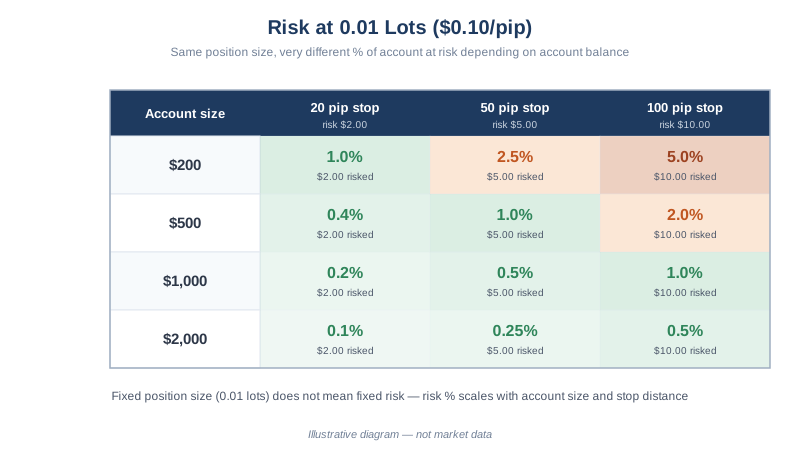
This is the arithmetic behind the $200 practical minimum in our XM deposit guide. ATR-based stops on H1 majors commonly land in the 30–60 pip band, so a $200 account trading 0.01 lots is running 1.5–3% risk per trade — at the edge of workable, and only with a single position open. Below $200 the calculation returns lot sizes under the broker minimum, at which point you either skip the trade or take 0.01 lots and accept whatever risk that implies.
Lot Size by Account and Stop Distance
Lots at 1% risk, EUR/USD, $10 per pip per standard lot:
Lots = (Balance × 0.01) / (Stop in pips × $10)
| Account | 20-pip stop | 50-pip stop | 100-pip stop |
|---|---|---|---|
| $200 | 0.01 | 0.004 — below 0.01 minimum | 0.002 — below 0.01 minimum |
| $500 | 0.02 | 0.01 | 0.005 — below 0.01 minimum |
| $2,000 | 0.10 | 0.04 | 0.02 |
| $10,000 | 0.50 | 0.20 | 0.10 |
Cells marked below minimum are the ones that matter. They are not telling you to trade 0.01 anyway; they are telling you the trade does not fit the account at 1% risk. Your three options are a tighter stop that the market structure has to justify, a larger balance, or not taking that setup. Rounding up to 0.01 is a fourth option people take without noticing they have taken it — on a $500 account with a 100-pip stop that is 2% risk, double what you specified.
Always round down. 0.033 becomes 0.03, not 0.04.
The table above uses one fixed example (EUR/USD, $10 per pip). Enter your own account balance, risk percentage, stop distance, and pair below to get the lot size for your actual trade — pip value now updates automatically when you change the pair. Bookmark the standalone position-size calculator if you want it without scrolling back to this guide.
Position-size calculator
Enter your account balance and stop-loss distance above to calculate.
Educational tool, not investment advice. Verify the calculation and your broker's minimum lot size before placing a trade.
Three things to check on whatever number it returns. Round it down to your broker’s lot step, never up. If it comes back below 0.01, the trade does not fit the account at that risk percentage — that is information, not an inconvenience. And re-enter your balance each session, because the result is a function of current equity, not of the balance you had when you last opened the page. If you would rather size the grid interval than the position, the grid spacing calculator is the companion tool.
Errors That Silently Change Your Risk
None of these produce an error message. They produce a position that is the wrong size while your spreadsheet says it is correct.
Contract size is not always 100,000 units. A “lot” is an instrument-specific convention. Spot gold is typically 100 ounces per standard lot, silver 5,000 ounces, index CFDs something else again. Applying the $10-per-pip rule to XAU/USD produces a position that is wrong by an order of magnitude. Check the contract specification for every new instrument.
Crosses need a two-step conversion. For EUR/GBP the pip value arrives in pounds and has to be converted into your account currency at the live GBP rate. That rate moves, so the pip value you calculated on Monday is not the one you get on Friday. Recalculate rather than reusing.
Account denomination changes the percentage. A pip on EUR/USD is $10 regardless of your account currency, but if your account is in euros that $10 is €9.22 at 1.0844 — and your risk percentage is measured in euros. A move in EUR/USD changes both the trade result and the conversion, so a euro-denominated account trading EUR/USD has a second, smaller exposure it did not intend.
Not recalculating as the balance moves. Position sizing is a function of current equity. A trader who computed 0.04 lots at $2,000 and keeps using it after a drawdown to $1,400 is now risking 1.43% instead of 1%. The drift is always in the dangerous direction, because it is the losses that change the denominator.
The mechanical fix for all four is the same: recompute from live balance and live pip value before every entry, and never carry a lot size over from the previous trade. An Expert Advisor does this on every signal from your configured risk percentage — which removes the arithmetic error, not the judgement about what percentage is right. To test the sizing behaviour without capital at risk, open a free XM account and run it on demo.
Further Reading
- Forex Trading for Beginners — the full roadmap this guide fits into
- Forex Risk Management Guide — streak arithmetic, sizing methods, and correlation caps
- XM Deposit Guide — why $200 is the practical minimum for an EA account
- Best Forex Pairs for Small Accounts — pairing small deposits with the right instruments
- Demo Account Guide — testing your sizing on simulated funds
This article is for educational purposes only and does not constitute financial advice. Trading forex carries significant risk. Start with a demo account before risking real money.