Affiliate disclosure: SteadyPips is an XM Introducing Broker; opening an account through a link here pays us a commission — see Affiliate Disclosure and Editorial Policy. Regulatory and cost figures below were re-checked 31 July 2026; full methodology is in “How We Reviewed This, and How This Page Is Funded” near the end.
Regulation and Entity: What We Could Verify
This section was rewritten on 31 July 2026 after re-checking each claim. One was wrong. For what a licence tier like CySEC, DFSA, or an offshore FSC actually protects — segregated funds, compensation caps, leverage limits — before reading XM’s specific numbers below, see our broader forex broker regulation explained guide.
| Claim | Status, July 2026 |
|---|---|
| CySEC (Cyprus), licence 120/10 — Trading Point of Financial Instruments Ltd | Consistently reported across XM’s own materials and independent directories. Confirm on the CySEC public register. |
| ASIC (Australia), AFSL 443670 | Removed from this page. trading.com’s own Australian regulation page presents AFSL 443670 (ACN 164 367 113) as held by Trading.com Markets Pty Ltd — a sibling brand, not XM. FxScouts reported in January 2026 that XM no longer accepts Australian residents. We do not describe XM as ASIC-regulated. |
| DFSA (Dubai), reference F003484 — Trading Point MENA Limited | The DFSA public register lists Trading Point MENA Limited. The reference is widely quoted as F003484, with at least one source giving F00348. Verify on the DFSA register. |
| Belize FSC — XM Global Limited | Registration confirmed, but the number is reported inconsistently: we found 000261/4, 000261/106 and 000261/397 attributed to XM Global across sources in July 2026. We are not going to pick one. Check the FSC Belize register of registered companies. |
We also saw reports (daytrading.com, late 2025) of a UAE Securities and Commodities Authority Category 5 licence; we have not verified it and place no weight on it here.
The general lesson outlives the numbers: a licence number quoted on a review site is not evidence. Numbers get copied forward for years after entities are renamed, sold or wound down — exactly what happened with the ASIC claim that used to sit on this page.
Which Entity Will You Actually Be Onboarded To?
This determines what your protections are worth, and it is decided by your country of residence, not the brand on the website.
| Your region | Likely entity | Regulator | Segregated funds | Negative balance protection | Compensation scheme | Retail leverage cap |
|---|---|---|---|---|---|---|
| EEA / Cyprus | Trading Point of Financial Instruments Ltd | CySEC | Yes | Yes | Investor Compensation Fund, capped per eligible client — verify the current cap with CySEC | ~1:30 major FX |
| UAE (DIFC) | Trading Point MENA Ltd | DFSA | Yes | Yes | No statutory scheme | ~1:30 major FX |
| Most other countries | XM Global Ltd | FSC Belize | As stated by the firm | As stated by the firm | None | Up to 1:1000 |
| US / Canada | Not onboarded | — | — | — | — | — |
| Australia | Not onboarded, as of January 2026 | — | — | — | — | — |
Stated plainly: if you are onboarded to the Belize entity, your recourse is materially weaker than under CySEC or an ASIC-tier regulator. No statutory compensation fund stands behind the account, permitted leverage is more than thirty times higher, and disputes resolve under Belize law. That may be an acceptable trade-off — but it is a trade-off, and most reviews do not mention one is being made. Check the entity named in the client agreement you sign.
Costs: Spreads, Commissions and Fees
As published by XM, retrieved 31 July 2026.
| Feature | Micro | Standard | Ultra Low |
|---|---|---|---|
| Min deposit | $5 | $5 | $5 |
| Spread from | 1.0 pip | 1.0 pip | 0.6 pips |
| Commission | None | None | None |
| Contract size | 1,000 | 100,000 | 100,000 |
| Min lot | 0.01 | 0.01 | 0.01 |
Typical published Standard spreads: EUR/USD 1.6 pips, GBP/USD 1.9, USD/JPY 1.5, AUD/USD 1.6. The “from” figures are best-case; plan around the typical.
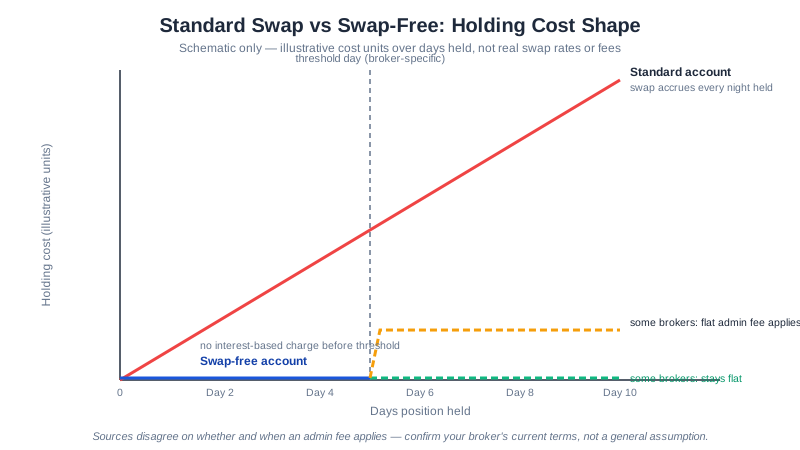
XM also offers a swap-free (Islamic) variant of each account type on request, replacing overnight interest with a different cost structure. See our swap-free (Islamic) forex accounts guide for how that works, who qualifies, and what it does and doesn’t remove from your cost stack.
A 0.1 lot EUR/USD position is $1 per pip. Round-trip cost is the spread, as neither type charges commission:
| Standard (1.6 pips) | Ultra Low (0.6 pips) | |
|---|---|---|
| Cost per 0.1-lot round trip | $1.60 | $0.60 |
| Cost per 1.0-lot round trip | $16.00 | $6.00 |
| Break-even gross edge required | 1.6 pips | 0.6 pips |
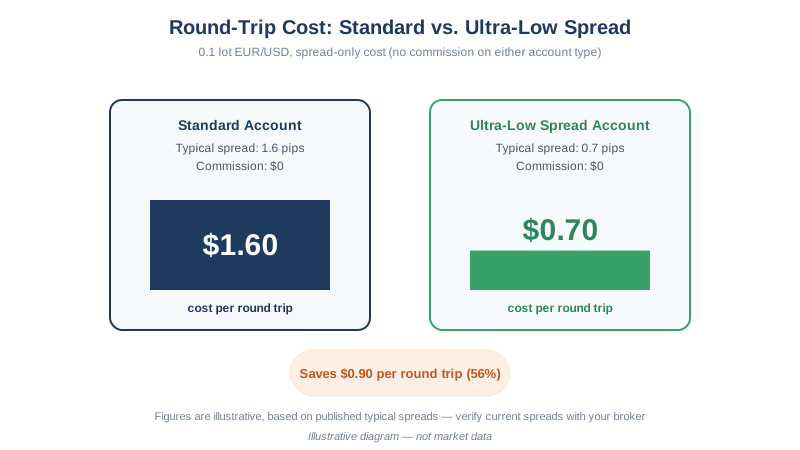
The third row matters most for automated trading. On Standard a strategy must produce more than 1.6 pips of gross edge per round trip before it earns anything; on Ultra Low the bar is 0.6 pips. For a strategy whose average winner is 8 pips, that is the difference between paying 20% and 7.5% of the average win.
Break-even volume, concretely. The gap is $1.00 per 0.1-lot round trip. On a $1,000 account that is 0.1% of equity per trade, so ten round trips a month costs about 1% of the account per month — roughly 12% a year — decided purely by which account type you opened. Our QuickPulse backtest took 521 trades in 26 months, about 20 a month; at 0.1 lots that implies an annual cost difference near $240. Choose on expected trade frequency, not the headline “from” spread.
Cost score: mixed. Ultra Low is competitively priced for a no-commission account. Standard is not — it exists mainly for traders who deposit below the amounts where Ultra Low’s typically higher minimums (verify the current figure) apply, and that convenience carries a real cost for anyone trading more than occasionally.
Platform and Execution
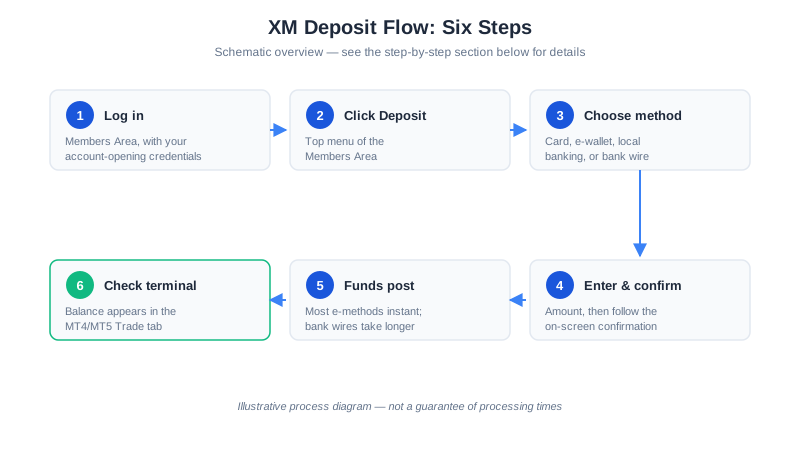
Both MT4 and MT5 are supported, account opening and verification were straightforward in our test, and the deposit flow (covered separately in our XM deposit guide) posted funds without friction.
Automated trading is not restricted, all order types are supported, hedging is permitted, and WebRequest can be whitelisted — which our EA verification flow requires. A free VPS is offered above a monthly volume threshold; check the current figure, as it changes.
We observed platform spreads during London and New York hours consistent with XM’s published typical figures above. We did not benchmark execution quality — fill rates, slippage, rejection rates — against other brokers, and we have no data comparing XM’s server-side performance to a competitor’s. Treat the “typical spread” numbers as the input to your cost model, not as a claim about execution quality, which is a separate and untested question.
Platform and execution score: solid for EA use, unverified on execution quality. No restriction we found blocks automated trading; the open question is fill quality under stress, which this review does not answer.
Support and Who XM Fits
Support. We did not test response times, dispute handling, or complaint resolution — the same gap noted above. XM advertises multiple contact channels (live chat, phone, email) across languages, which is standard for a broker at this scale, but a channel existing is not evidence of how well it performs under a real problem. If support quality is decisive for you, treat this section as an open question rather than a rating.
Who XM is not right for:
- Residents of the United States or Canada. Not onboarded.
- Scalpers and high-frequency EAs on a Standard account. A typical 1.6-pip EUR/USD spread consumes most of a small average win. Use Ultra Low, or a different broker — see spreads and commissions.
- Anyone treating 1:1000 leverage as a feature. At 1:1000, one standard EUR/USD lot needs roughly $100 of margin, and a 10-pip adverse move is $100 — all of it. Leverage does not raise expected return; it shortens the distance between an ordinary move and a closed-out account. Regulated entities cap retail leverage near 1:30 because of that arithmetic; the offshore entity’s willingness to offer 1:1000 is a difference in protection, not generosity. Size the position by risk percentage instead — the position-size calculator does that math directly.
- Anyone funding an account then leaving it idle. An inactivity fee of $5 per month after 90 days is reported consistently across 2026 broker directories; confirm the current figure with XM before depositing.
- Anyone who needs statutory compensation cover and would be onboarded to the Belize entity.
Verdict and Scorecard
| Category | Assessment | Basis |
|---|---|---|
| Regulation & trust | Split — solid under CySEC, materially weaker offshore | Regulation and Entity section above |
| Costs | Competitive on Ultra Low, wide on Standard | Costs section above |
| Platform & execution | Unrestrictive for EAs; execution quality untested | Platform and Execution section above |
| Support | Not independently tested | Support section above |
For a beginner or EA trader onboarded to a regulated entity, XM is a reasonable, unrestrictive platform: a $5 minimum deposit, no limits on automated trading, both MetaTrader builds, and Ultra Low spreads that are competitive for a no-commission account. Those are real strengths, and they are why we use it.
The caveats are equally real. Most non-EEA readers will be onboarded offshore, where protections are weaker than the “multi-regulated broker” framing implies. Standard spreads are wide for anything trading frequently. And 75.12% of retail accounts here lose money. Our recommendation is conditional on you checking which entity you sign with — and it is made by a party paid when you sign.
Open a free XM account if that trade-off works for you, or test the platform on a demo account first.
How We Reviewed This, and How This Page Is Funded
Affiliate disclosure, before anything else. SteadyPips is an XM Introducing Broker. If you open an account through a link on this page and trade, XM pays us a commission derived from your activity. You pay the same spreads either way, but the incentive is real and you should read this review knowing it exists — see our editorial policy and affiliate disclosure.
Figures in this review. Spreads, fees, account specifications and licence details were retrieved on 31 July 2026 and change without notice. Verify current terms on XM’s own regulation and legal documents pages, and check any licence number on the regulator’s own public register, not a broker directory. Where sources disagreed, we say so below.
The risk disclosure, in the body where it belongs: XM discloses that 75.12% of retail investor accounts lose money when trading CFDs with this provider. That is the most useful number on this page. It is not a statement about XM specifically — comparable brokers publish comparable figures — but it is the base rate against which to set any expectation.
What we tested: the account opening and verification flow; MT4 and MT5 compatibility with our seven Expert Advisors, including WebRequest whitelisting for our verification endpoint; the deposit flow; and platform spreads observed during London and New York hours.
What we did not test, and what you should not infer: withdrawal speed at meaningful size, complaint and dispute handling, execution quality benchmarked against other brokers (fill rates, slippage, rejections), and long-run uptime. Those four separate brokers under stress, and we have no data on any of them. Read this as a review of the retail-facing product, not of how the firm behaves when something goes wrong.
Continue Your Research
- What is an Expert Advisor?
- Understanding Spreads and Commissions
- Do You Need a VPS for Forex EA Trading?
- XM Deposit Guide
Risk Warning: trading CFDs and forex involves significant risk. 75.12% of retail investor accounts lose money when trading CFDs with this provider. Consider whether you understand how CFDs work and whether you can afford the high risk of losing your money. Read our risk disclosure.