Most “best broker” round-ups are a ranking with an affiliate link attached — not very useful, since the broker that suits a $200 account in Kenya isn’t the one that suits a $20,000 account in Germany, and the entity that onboards you, which decides your actual protection, depends on where you live, not which site you read.
This is a method instead: answer four questions yourself for any broker, including the six below — which entity holds my money, which regulator supervises it, what does that regulator protect, and what does this cost per trade.
Disclosure: SteadyPips is an Introducing Broker for XM; XM pays us if you open an account via a link here. The other five brokers below don’t. Full detail is in “How This Page Is Funded” below; see also our Editorial Policy.
Six Brokers, Compared
Listed alphabetically — not a ranking, and given our XM relationship, we’re not the right party to name a “best” broker for you.
| Broker | Minimum deposit | Main entities and regulators | Max leverage | US clients | Notable limitation |
|---|---|---|---|---|---|
| Exness | $1 (Standard); $200 (Pro, Raw Spread, Zero) | CySEC 178/12; FCA (UK); FSA Seychelles SD025; FSC Belize; FSC BVI; FSCA; CMA | Up to 1:Unlimited on the Seychelles entity, subject to eligibility; 1:30 retail under FCA/CySEC | No | Extreme leverage marketed as a feature; most non-EU clients onboard offshore |
| FXCM | $50 | Stratos Markets Ltd (FCA, FRN 217689); Stratos Europe Ltd (CySEC 392/20); Stratos Trading Pty Ltd (ASIC); Stratos Global LLC (SVG) | Varies by entity | No — barred from US retail forex since 2017 | Australian entity under an ASIC stop order from December 2025; other regions onboard via SVG |
| IC Markets | $200 (all account types) | International Capital Markets Pty Ltd (ASIC); IC Markets (EU) Ltd (CySEC); Raw Trading Ltd (FSA Seychelles, SD018) | Up to 1:500 on forex via the Seychelles entity; 1:30 retail under ASIC/CySEC | No | Highest entry deposit here; no US access |
| OANDA | $0 for standard accounts (≈$200 suggested to meet margin) | FCA (UK); CFTC/NFA (US); CIRO (Canada); ASIC (Australia); MAS (Singapore) | Tightly capped for US retail clients by CFTC rules; 1:30 retail in UK/EU/AU | Yes | Costs generally not the lowest; US leverage far below offshore norms |
| Pepperstone | No fixed minimum (≈$200 suggested for margin) | FCA (UK); ASIC (Australia); CySEC; BaFin (Germany); DFSA; SCB (Bahamas); CMA (Kenya) | 1:30 retail in UK/EU/AU; higher offshore | No | No US access; entity and protection vary widely by country |
| XM | $5 (Micro, Standard, Ultra Low) | CySEC 120/10 (Cyprus); XM Global Limited (FSC Belize); DFSA (UAE); FSCA (South Africa); CMA (Kenya); FSA (Seychelles); FSC (Mauritius) | Up to 1:1000 on the offshore entity; 1:30 retail under CySEC | No | Standard-account EUR/USD spread wide for scalping; most non-EU clients onboarded by the Belize entity; no US or Canada clients |
Every figure in this table is as published by the broker concerned, July 2026 — verify current figures before you deposit. Terms, entity structures and leverage caps change without notice, and several of these brokers publish different numbers on their regional sites.
Four need only a line each, all as published by the broker named, July 2026 — verify current figures. Exness opens at $1, useful for learning at trivial size; its “unlimited” leverage is not a feature to use. IC Markets asks $200 on every account type and prices in raw spreads, which suits cost-sensitive automated strategies. OANDA has no standard-account minimum and the widest Tier-1 footprint here, including the group’s only US retail licence. Pepperstone has no fixed minimum, four Tier-1 regulators and the broadest platform choice, but which of its seven entities onboards you varies sharply by country.
FXCM (as published by FXCM, July 2026 — verify current figures) takes $50, with strong research behind FCA and CySEC entities. Two facts belong in plain sight: in 2017 the CFTC fined FXCM $7 million, the firm withdrew its US registration as part of the settlement and the NFA barred it, so it has not served US retail forex clients since; and its Australian entity has been under an ASIC stop order since December 2025. Neither makes the FCA entity unusable today, but any article calling FXCM “NFA regulated (USA)” — including an earlier version of this page — was simply wrong.
XM (as published by XM, July 2026 — verify current figures) takes $5 and runs MT4 and MT5 with no restrictions on Expert Advisors, under a CySEC licence for EU clients. Its weaknesses are real: the Standard account’s EUR/USD spread is wide enough to hurt short-horizon strategies (the Ultra Low account exists for that reason), clients outside the EU are generally onboarded by XM Global Limited under Belize regulation rather than by the Cypriot entity, and residents of the US and Canada cannot open an account at all. XM’s Australian licensing has changed in recent years too — check the register for your region rather than trusting any review, ours included.
The Four Things Worth Comparing
1. Which entity onboards you. Large brokers are groups of separate companies. “FCA regulated” on a homepage often means one subsidiary is FCA regulated while your account agreement is with an offshore sibling. Find the company name in the client agreement before depositing: that name, not the brand, is who owes you your balance.
2. Total cost per trade. Spread plus commission plus swap, on the pair and account type you will actually use. A “from 0.0 pips” headline usually means a commission-based account; a zero-commission account recovers the cost in the spread. Our guide to spreads and commissions compares the two on equal terms.
3. Withdrawal reliability. Harder to research and more important than spreads. Deposit a small amount, trade it, withdraw it, and time the round trip before funding properly.
4. Platform fit. To run an Expert Advisor you need MetaTrader 4 or 5, no restrictions on automated trading, and ideally a VPS option. To trade manually on a phone, none of that matters.
Leverage is mostly a distraction. A beginner on 1:30 and one on 1:1000 can open the same position; the difference is only how much margin sits idle. High leverage does not improve a strategy, it shortens the time until a mistake becomes terminal.
How to Verify a Licence Number Yourself
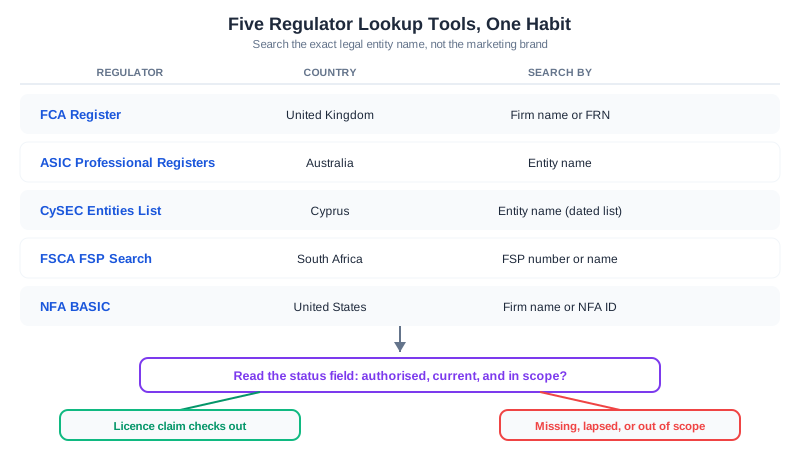
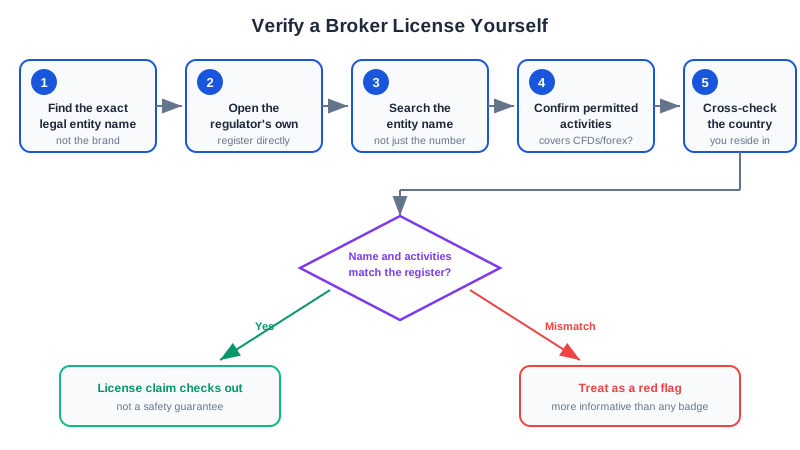
This takes about three minutes and is the highest-value check a beginner can do. Find the regulator and licence number in the footer or legal page of the broker’s site, then look it up:
- FCA (United Kingdom) — register.fca.org.uk — search the firm name or Firm Reference Number. An authorised firm shows status “Authorised” plus the activities it may carry out. The FCA also warns about clone firms that copy a real FRN but give different contact details.
- ASIC (Australia) — asic.gov.au professional registers search — search by company name, ACN/ABN, or Australian Financial Services licence number.
- CySEC (Cyprus) — cysec.gov.cy regulated entities — each listing shows a Cyprus Investment Firm’s licence number and current status.
Three checks matter more than the licence merely existing:
- Does the register’s company name match your client agreement? If the register says “Example Markets Ltd” and your agreement says “Example Global LLC”, you are a client of the second one and the first one’s licence is not yours.
- Is the status current, and are there conditions on it? Registers show suspensions and stop orders. In December 2025, ASIC stopped FXCM’s Australian entity, Stratos Trading Pty Limited, from issuing CFDs or opening new accounts over deficiencies in its target market determination — the kind of thing that shows on a register and never in a review.
- Do the permissions cover what you are being sold? A licence to arrange deals is not a licence to hold client money.
What Regulation Protects — and What It Does Not
Regulation is not a safety net under your trading. It is a set of rules about how a firm handles your money. In the stronger jurisdictions you generally get:
- Segregation of client money — your funds sit apart from the firm’s working capital and are not used to run the business.
- Negative balance protection for retail clients in the UK, EU and Australia — a gap or spike cannot leave you owing the broker more than your deposit. Clients reclassified as professional or wholesale typically give this up for higher leverage.
- A compensation scheme, in some places only. Coverage varies sharply by jurisdiction and does not follow you to an offshore entity:
| Jurisdiction | Scheme | Coverage |
|---|---|---|
| UK | FSCS | Up to £85,000 per person per firm, for failures after 1 April 2019 |
| Cyprus | Investor Compensation Fund | The lower of 90% of a covered claim and €20,000 |
| Australia | None (statutory) | No fixed-amount fund for CFD clients; ASIC-licensed firms must instead belong to AFCA, a free dispute-resolution scheme that decides cases individually |
What regulation does not do: reduce market risk, make leverage safe, recover trading losses — or, the point most beginners miss, follow you across entities. If an offshore subsidiary onboards you, the FSCS and the ICF are irrelevant however many Tier-1 licences the group holds elsewhere. Offshore regulation is not automatically fraudulent; large brokers use it to serve clients whose countries offer no licensing route. It just means the compensation layer is thinner, and you should know that beforehand.
Red Flags of an Unregulated Broker
- No named legal entity, registered address, or licence number anywhere on the site.
- A licence number that does not resolve on the register, or resolves to a different company name. This is the clone-firm pattern the FCA publishes warnings about.
- Promises of fixed monthly returns or “no-loss” accounts. No legitimate broker can promise a return.
- Bonuses with withdrawal conditions attached, or funds that unlock only after a volume target.
- Instant card deposits, but withdrawals needing a phone call, a document you already sent, or a “manager’s approval”.
- An account manager who contacts you unprompted, pushes a larger deposit, or suggests raising leverage after a loss.
- Sponsored reviews and testimonials as the only evidence of legitimacy, with nothing on a public register.
If a broker fails the register check, nothing else about it matters — not the spreads, not the platform, not the education section.
How This Page Is Funded
We are not a neutral party. SteadyPips is an Introducing Broker for XM. XM appears in the comparison table above. When a reader opens an XM account through one of our links and trades, XM pays us a commission — that is how this site is funded and how our Expert Advisors stay free.
The other five brokers here — Exness, FXCM, IC Markets, OANDA and Pepperstone — pay us nothing. We have no commercial relationship with any of them, so no financial reason to place them above or below XM, but you should assume we know XM’s platform better than theirs.
Details: Affiliate Disclosure and Editorial Policy. If you would rather not use an affiliate link, every broker above can be reached directly and every figure in this article can be checked on a public register.
How We Compiled This, and What We Did Not Test
What we did: read each broker’s published terms, account pages and client agreements in July 2026; cross-checked entity names, licence numbers and status against the FCA, ASIC and CySEC registers linked above; checked the public record of the CFTC action against FXCM; and recorded minimum deposits and leverage caps as the brokers publish them.
What we did not do: we did not open or fund live accounts at Exness, FXCM, IC Markets, OANDA or Pepperstone, and we have not measured their spreads, slippage, requotes, execution speed, swaps or withdrawal turnaround. Any article claiming live-account comparisons across five or six brokers is very likely doing the same desk research — the previous version of this page implied otherwise in its title, which is one reason it was rewritten.
Our known bias: a commercial relationship with XM and none with the others, plus hands-on experience of XM’s platform because our EAs run on it. Weigh the XM paragraph accordingly.
A Sensible Order of Operations
- Demo for two to four weeks — learn the platform where mistakes are free (demo account guide).
- Verify the entity and licence on the registers above, before depositing anything.
- Fund small and test the round trip — deposit, trade, withdraw. That tests the broker’s operations, not your strategy.
- Size from risk, not from available leverage — 1-2% per idea (lot sizing).
- Only then scale, and re-read the agreement if your account is ever migrated to another entity.
The Bottom Line
There is no best broker for beginners, only one whose entity, costs and protections fit your situation. The four checks — which entity, which regulator, what protection, what cost — take under an hour and will serve you long after this table is out of date.
To see how we assess a broker in depth, our XM broker review is the most detailed one we have written — and to be explicit, XM is the broker that pays us, so treat it as an affiliate-related review and verify the licence and spread figures yourself on XM’s site and the CySEC register before acting on it. Our free MT4 and MT5 Expert Advisors are available whichever broker you research; they run on any MetaTrader platform that permits automated trading.
Risk Disclaimer
Forex and CFD trading carries a substantial risk of loss and is not suitable for all investors. Leverage amplifies losses as well as gains. This article is educational, reflects publicly available information as of July 2026, and does not constitute investment advice or a recommendation of any broker. Regulatory status, fees, entity structures and account terms change; always confirm current details with the broker and the relevant regulator. Only trade with capital you can afford to lose, and test any strategy on a demo account first.